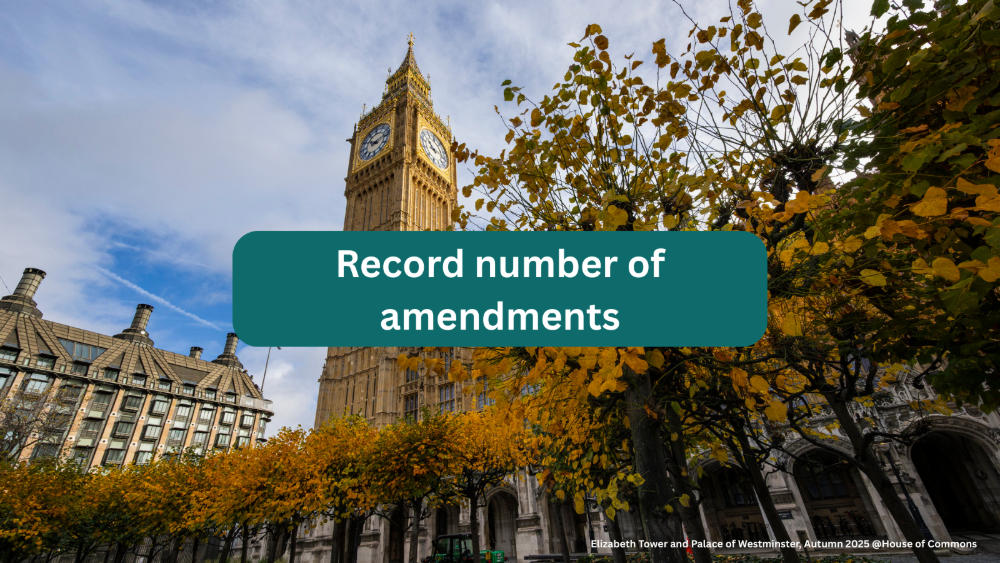
 The Terminally Ill Adults (End of Life) Bill now has 1,227 proposed amendments at Committee Stage – more than any other Bill in the history of the UK Parliament. Humanists UK and My Death, My Decision highlight that many of the amendments are unworkable, repetitive, and unnecessary, and urge peers to withdraw their amendments.
An historic record
The Bill is currently in Committee Stage in the House of Lords, where peers debate but often don’t even vote on amendments. The number of amendments beats the previous record of the 2005-6 Companies Bill, which had 1,224 amendments at Committee Stage, largely due to the technical consequences of rewriting a sprawling area of law into one coherent code – lots of changes on paper, but many aimed at consolidation.
| Terminally Ill Adults (End of Life) Bill 2024 | 2005-6 Companies Bill |
| 51 pages | 552 pages |
| 59 clauses, 3 schedules | 855 clauses, 15 schedules |
| 1,227 amendments | 1,224 amendments |
| 24 amendments per page | 2.2 amendments per page |
| Single core issue (assisted dying framework + safeguards) | Multiple issues / whole code area (company law across many domains) |
Seven peers opposed to the Bill have proposed 666 amendments:
| Baroness Finlay of Llandaff | 191 |
| Baroness Grey-Thompson | 130 |
| Baroness Coffey | 94 |
| Lord Carlile of Berriew | 72 |
| Lord Sandhurst | 71 |
| Lord Goodman of Wycombe | 61 |
| Lord Moylan | 46 |
Several amendments are unworkable, repetitious and unnecessary, including:
- Amendment 458 (Baroness Grey-Thompson), which proposes that every applicant must supply a negative pregnancy test – including men, people over 75, those infertile, etc.
- Amendments 236 (Lord Moylan) & 752 (Lord MacKinlay) which seek to prevent the NHS from being involved in any way.
- Amendments 367, 368 & 369 (Lord Goodman of Wycombe), which propose to increase the number of assessment stages from two independent doctors and a panel to five doctors and a panel, the fifth being a geriatrician. This would be impossible to navigate for a terminally ill person with fewer than six months to live.
- Amendment 15 (Baroness Coffey), which proposes excluding anyone who has left the UK in the previous twelve months, banning anyone who has been on holiday or received a six-month terminally ill prognosis while abroad.
- Amendments 4, 249, 257, 304, 337, 446, & 448 (Baroness Berger) and 5, 250, 258, 305, 338, 447, & 449 (Baroness Lawlor). These all seek to increase the age of eligibility from 18 to 25 or 21, respectively, banning a terminally ill 19-year-old.
- Amendment 890 (Lord Moylan), which proposes to introduce guidance ‘aimed at preventing any growth of an institutional culture in the medical professions and among hospital managers in favour of assisted death as a means of procuring human organs for transplant’.
- Amendments 426A & 426B (Baroness Coffey), which propose that the terminally ill person must be physically present in a court open to the public.
- Amendments 19 (Lord Rook), 20 (Baroness O’Loan), 21 (Baroness Grey-Thompson), 28, 29 (Baroness Finlay), 30B, 265A, 443A (Baroness Lawlor). These are all similar amendments that propose GP requirements that would shut terminally ill out of assisted dying.
Peers spent nearly an hour debating a group of probing amendments from Lord Frost that would change the wording of ‘assistance to end their own life’ in the Bill to ‘medical help to commit suicide by provision of lethal drugs’. These amendments add nothing to the clarity, workability or safety of the Bill and replace neutral, clinically accurate language with stigmatising terminology.
Humanists UK and My Death My Decision have identified several instances of peers being explicitly clear that they are trying to block the Bill by means other than it being voted down.
If the Bill does not complete all stages in the Lords by 24 April, the last sitting Friday announced, the Bill will fail. The Parliament Act can be used to bypass the House of Lords.
Dave Sowry, Board Member of My Death, My Decision, said:
‘Peers have tabled an unprecedented number of amendments, but volume is not scrutiny. Too many of these proposals are repetitive, impractical, or designed to gum up the Bill rather than improve it. If an amendment can’t work in practice, it should be withdrawn.’
‘This Bill is about giving terminally ill people choice, with strong safeguards. Amendments that pile on impossible hurdles don’t make anyone safer; they just make the law unusable for the people it is meant to help.’
Notes
Members of the MDMD team, as well as individuals affected by the current law on assisted dying, are available for interview upon request
For further comment or information, media should contact Nathan Stilwell at nathan.stilwell@mydeath-mydecision.org.uk or phone 07456200033. (media only)
Media can use the following press images and videos, as long as they are attributed to “My Death, My Decision”.
My Death, My Decision is a grassroots campaign group that wants the law in England and Wales to allow mentally competent adults who are terminally ill or intolerably suffering from an incurable condition the option of a legal, safe, and compassionate assisted death. With the support of over 3,000 members and supporters, we advocate for an evidence-based law that would balance individual choice alongside robust safeguards and finally give the people of England and Wales choice at the end of their lives.