The island of Jersey has passed its historic Assisted Dying Law, after States Members voted in favour by 32 votes to 16. My Death, My Decision, a member of the Assisted Dying Coalition alongside End of Life Choices Jersey, welcomes this historic moment, and urges the rest of the UK to move forward in confidence with passing safe, compassionate assisted dying legislation.
Dave Sowry, Board Member of My Death, My Decision, said:
‘Massive congratulations to the States Assembly of Jersey for having a debate that was rooted in compassion and empathy. Politicians did an excellent job putting themselves in the shoes of the terminally ill, and they should be proud of the respectful debate they had.
‘I wish we could say the same of the debate on assisted dying happening in Westminster, which is currently facing a filibuster by a small group of members of the House of Lords, who are adamantly opposed to the law change. The Tynwald in the Isle of Man voted in favour of assisted dying, now the States Assembly in Jersey has followed suit, will the terminally ill people of England and Wales be left behind?’
The debate:
The States Assembly began by debating a series of amendments to the Draft Legislation, many recommended by the Review Panel. These amendments include both principled changes to the draft law, such as allowing waiver of future consent, and practical changes, such as replacing one of the doctors if they can’t continue assessing.
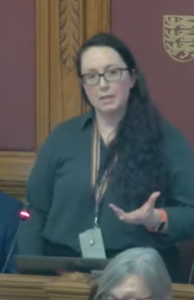 Deputy Louise Doublet, States Assembly member, said:
‘This is one of the most meaningful things we can do for our island. Death is never an easy thing, but it’s something everyone will face. If we can improve this legislation today, which has extremely rigorous and robust safeguards and principles underpinning it, we can be really proud of it as an Assembly.
‘It is a compassionate gift we are giving our island. As a humanist, I am guided by principles of compassion… It will make some really difficult moments in people’s lives a little bit less painful.’
Deputy Helen Miles, States Assembly member, said:
‘I do not share the theological view that the timing and manner of death must be determined by divine authority; others in this assembly do hold that belief, and I do respect that sincerity and the integrity with which they argued their case. But we legislate for a plural society, and within that society, competent adults must be permitted to make deeply personal decisions about their own lives.
‘I have been thinking of Jersey man Alain Du Chemin, who came and addressed the Citizens jury in April 2021. He was terminally ill, and he asked, “What makes anybody think that they have the right to force me to die in a particular way that I don’t want?” That question has echoed throughout this process. And today, the Assembly is going to answer.
‘Today we have the opportunity to improve dignity at the end of life.’
What happens next?
The Law will now go to the Privy Council for Royal Assent. The Assisted Dying Bill in the Isle of Man has been awaiting Royal Assent for nearly a year. This has the potential to cause a democratic crisis.
The Assisted Dying Law will not come into force for another 18 months, likely late summer 2027.
How does it compare to the Terminally Ill Adults Bill in Westminster?
Several elements are almost identical in both Bills. The applicant must:
- Be an adult.
- Be terminally ill.
- Have a clear mental capacity and a settled wish to die.
- Be assessed by two independent doctors.
- Be ordinarily resident for at least 12 months in the relevant jurisdiction.
- Be able to withdraw or cancel at any point along the way.
Both Bills introduce new criminal offences for abuse of the system as well as conscientious objection or a ‘right to refuse’ protections for healthcare professionals.
However, there are some core differences between the two Bills:
- Both Bills are for people with six months left to live or fewer, but the Jersey Bill allows people with a neurodegenerative condition like motor neurone disease to apply if they have twelve months left to live.
- The Jersey Bill includes a subjective suffering element: the person believes they cannot bear the suffering the condition is causing (or is expected to cause).
- In addition to the two doctors, the Westminster Bill requires the applicant to be approved by a panel of a social worker, a lawyer, and a psychiatrist; the Jersey Bill does not require this.
- The Jersey Bill has one 14-day reflection period that can be overridden if the person will die imminently. The Westminster Bill has two reflection periods, the first is seven days, the second is 14 days; only the second can be overridden.
History of change on assisted dying in Jersey
There is a clear democratic mandate for assisted dying in Jersey.
In 2018, 1,861 Jersey residents signed a petition calling for the States Assembly to allow for assisted dying. In 2019, there was an online public survey, a GP and doctors’ survey, and a public meeting, and these all indicated strong support in the community for assisted dying. This led to the Jersey Assisted Dying Citizens’ Jury, a world-class democratic project, and its report and recommendations in 2021 overwhelmingly supported assisted dying. Humanists UK Chief Executive Andrew Copson gave oral evidence to the citizens’ jury.
Notes
Members of the MDMD team, as well as individuals affected by the current law on assisted dying, are available for interview upon request
For further comment or information, media should contact Nathan Stilwell at nathan.stilwell@mydeath-mydecision.org.uk or phone 07456200033. (media only)
Media can use the following press images and videos, as long as they are attributed to “My Death, My Decision”.
My Death, My Decision is a grassroots campaign group that wants the law in England and Wales to allow mentally competent adults who are terminally ill or intolerably suffering from an incurable condition the option of a legal, safe, and compassionate assisted death. With the support of over 3,000 members and supporters, we advocate for an evidence-based law that would balance individual choice alongside robust safeguards and finally give the people of England and Wales choice at the end of their lives.