UK Parliament

Covid-19 has exposed the need for a review of our assisted dying laws, says MDMD to parliamentary human rights committee

My Death, My Decision has responded to the Joint Committee on Human Rights’ review of Covid-19, by calling for an immediate review of the UK’s laws on assisted dying. 

In a submission to a consultation asking for opinions on the human rights impact of the Government’s extended lockdown, MDMD highlighted concerns that people suffering from terminal or incurable illnesses may have postponed their decision to travel to Switzerland if they thought it was prohibited under lockdown measures – and now risked having lost their opportunity for a dignified death in the future. The submission also discussed the incident where MDMD was aware of someone bringing forward their plans to end their life, because they feared restrictions might prevent them from doing so at a later stage. 

My Death, My Decision’s Chair Trevor Moore said: 

‘In many ways the onset of Covid-19 has given us all a glimpse into the lives of someone suffering from a terminal or incurable illness. But whilst our sense of losing control over our lives or fearing the prospect of a drawn-out period of suffering may only have been temporary, theirs sadly is not. Amidst the uncertainty of lockdown earlier this year, we understand that some people who had been ‘greenlit’ for an assisted death in Switzerland chose to postpone their journeys, and did so at the risk of losing their opportunity of going in the future. And sadly, we have now all learnt that they may have made this sacrifice and lost that final bit of control over their lives, without having had to.’

‘If nothing else, Covid-19 has demonstrated the frailty of end-of-life choices available in our country, and as we look to the future it has given a fresh impetus for a review into what needs to change. We encourage the UK Government and Parliament to grasp the issues exposed by our recent lockdowns and follow in the footsteps of our progressive neighbours, such as Canada, by instigating a thorough and widespread examination of our laws on assisted dying and end-of-life care.’ 

Notes:

For any more information or comment please contact My Death, My Decision’s Campaigns and Communications Manager at campaigns@mydeath-mydecision.org.uk.

Read our full consultation response. 

Read more about My Death, My Decision’s campaign for an inclusive change in the law: https://www.mydeath-mydecision.org.uk/

My Death, My Decision is a grassroots non-profit organisation that campaigns for a balanced and compassionate approach to assisted dying in England and Wales. As a growing movement, we are at the forefront of social change: nearly 90% of the public now favours a change in the law to allow adults of sound mind, who are either terminally ill or facing incurable suffering, the option of a peaceful, painless, and dignified death.

Read more

A generation of assisted dying campaigners demand an inquiry into the law

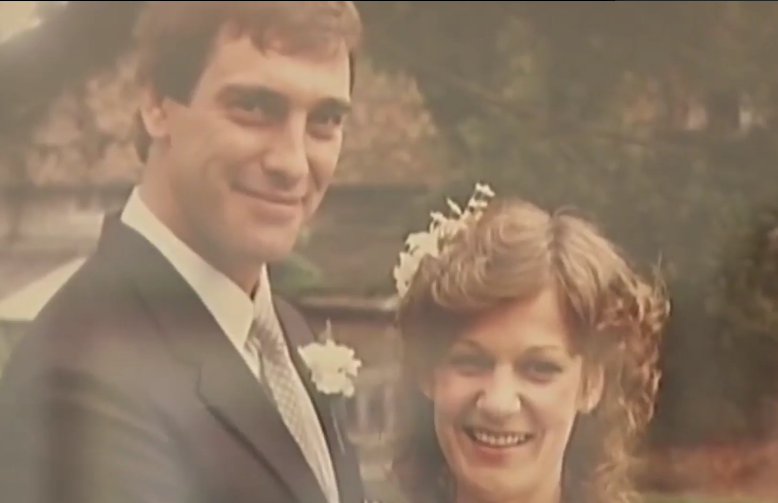
Jane Nicklinson, one of the signatories of the letter, alongside her husband Tony, who had locked-in syndrome in the run-up to his death in 2012. Credit: Andi Reiss ‘Endgame’

The families and living claimants from most of the past right-to-die cases have come together for the first time, and called for an inquiry into assisted dying. In a joint letter, the campaigners, involved in more than two decades of legal cases, say that recent evidence now makes the case for an inquiry ‘overwhelming’ and have urged Parliament not to ‘turn a blind eye’ to the suffering caused by the current law. 

The intervention follows just days after a leading Conservative MP, Andrew Mitchell, claimed that assisted dying could now be legalised within four years. 

The full statement, published in The Guardian today, reads: 

We represent the families and living claimants of most of the previous assisted dying legal cases. We have come together, for the first time, because we now believe there is an overwhelming case to set up an inquiry into the law.

It has now been half a decade since Parliament last examined legislation to legalise assisted dying, and fifteen years since it formally scrutinised the evidence. In that time, the number of Britons travelling to Switzerland had rocketed sixfold; successive countries, including Canada, Germany, Italy, and parts of the United States and Australia have legalised assisted dying, demonstrating that such changes can be achieved in a safe and compassionate way; public opinion has dramatically risen to nearly 90% supporting a change in the law for the terminally ill and incurably suffering; and there has been a significant shift in medical opinion and from within the disability community.

Following our unsuccessful legal cases, it is now obvious that parliamentarians alone have a responsibility to look at this matter again. They must not allow our cases to become the final word on the matter, or else countless others will experience the indignity, suffering, and agony that we can attest that this law creates. 

The evidence on assisted dying has simply changed, and Parliament cannot afford to turn a blind eye any longer.

My Death, My Decision’s Chair Trevor Moore said: 

‘Since the UK Parliament last considered an assisted dying law, an increasing number of jurisdictions worldwide – Canada, several states in the US and Australia, and other European countries – have adopted or are actively considering assisted dying laws. Contrary to what opponents claim, these other countries have shown that an assisted death is a choice that stands alongside palliative care as part of end of life choices, not in opposition to it.

Meanwhile, as several opinion polls have confirmed, the public is now overwhelmingly in favour of an assisted dying law – well over 80% and as high as 90% for some scenarios.

Yet the UK Parliament remains deaf to the pleas of those who wish to avoid suffering painful and traumatic deaths, such as the brave campaigners who have brought  legal cases against the Government to allow an assisted death. 

The time for politicians to stop ducking this much-needed human right is now. We at My Death, My Decision remain committed in our campaign to achieve a law to embrace both the incurably suffering and the terminally ill.’

Notes:

For any more information or comment please contact My Death, My Decision’s Campaigns and Communications Manager at campaigns@mydeath-mydecision.org.uk.

Read more about My Death, My Decision’s campaign for an inclusive change in the law: https://www.mydeath-mydecision.org.uk/

My Death, My Decision is a grassroots non-profit organisation that campaigns for a balanced and compassionate approach to assisted dying in England and Wales. As a growing movement, we are at the forefront of social change: nearly 90% of the public now favours a change in the law to allow adults of sound mind, who are either terminally ill or facing incurable suffering, the option of a peaceful, painless, and dignified death.

Read more

Parliament could legalise assisted dying within 4 years, says ex Cabinet Minister

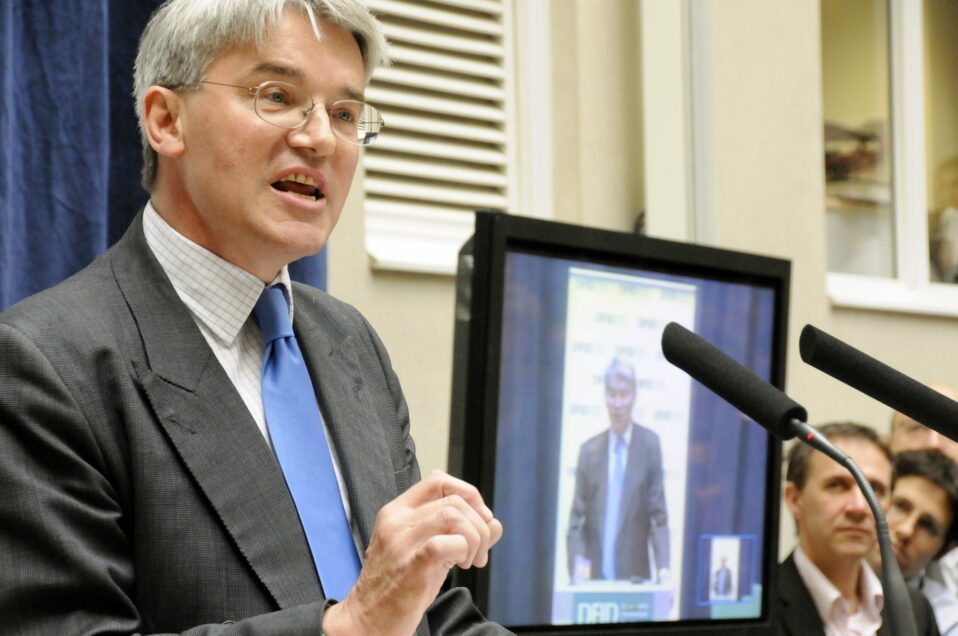
Credit: DFID at https://bit.ly/2FZGXEP

Conservative MP, Andrew Mitchell, in a recent Sky News interview, suggests that the law on Assisted Dying may change within this parliament. ‘I was, as a student and as a young MP, adamantly opposed to Assisted Dying and over the years my view has changed completely’ he said. His comments have been welcomed by right-to-die campaigners, and follows after Daniel Kawcynski MP claimed his view on Assisted Dying had changed.

In his interview Andrew Mitchell goes on to say that the change he wishes to see is limited to those within six months of dying. However doctors point to the impossibility of accurately giving a life expectancy, leading to a broader definition of ‘terminally ill’ in Scotland, with calls for similar changes in England and Wales.

Meanwhile, Canada’s law is evolving to remove any requirement to predict life expectancy and follows a more flexible approach. Because doctors are unable to accurately predict life expectancy, that flexibility overcomes a significant medical concern. The Canadian step-by-step approach shows a cautious, careful development, not the ‘slippery slope’ hyped by opponents.

MDMD’s Lead Campaign Commentator, Phil Cheatle, said:

 ‘It is gratifying to see MPs increasingly changing their minds in favour of assisted dying. However, in his proposal Andrew Mitchell fails to address the weaknesses of the arbitrary six month limit. As Lord Neuburger put it in the Tony Nicklinson legal case, ‘There seems to me to be significantly more justification in assisting people to die if they have the prospect of living for many years a life that they regarded as valueless, miserable and often painful, than if they have only a few months left to live.’ (Tony Nicklinson suffered from locked in syndrome – a non-terminal condition which made his life intolerable for him.)’

‘What is needed is a thorough and open evaluation of the options for assisted dying legislation, learning from countries like Canada, before picking any particular approach. In particular, we need to ensure that anyone who feels they might be vulnerable to inappropriate use of assisted dying legislation has adequate protection. We also need to avoid arbitrary restrictions that would prevent access to the legislation for some of those facing incurable suffering, when that is their own, informed and settled wish. With the rise in incurable degenerative diseases, many people are “dying” for much longer than six months. Appropriate use of the legislation should be determined by incurable suffering, in whatever form that takes, and personal choice, not unreliable estimates of life expectancy.’

Read more

Assisted dying campaigner Phil Newby refused permission by Court of Appeal

Phil Newby has been denied permission by the Court of Appeal to challenge the UK’s prohibitive law on assisted dying. 

Phil, 49, a father of two and member of My Death, My Decision, suffers from the degenerative condition motor neurone disease. His legal case had raised over £48,000 in donations from the public and had asked for the right to undertake a detailed examination of the evidence on assisted dying, and the ability to cross-examine expert witnesses. 

In November, he lost his High Court case, with judges saying court was ‘not an appropriate forum for the discussion of the sanctity of life’. 

The latest development follows shortly after the Secretary of State for Justice, Robert Buckland, signaled an interest in initiating a call for evidence on assisted dying – which Mr Newby has pledged to support by providing over nine-box files of evidence in support of a change in the law. 

Reacting to the Court of Appeal’s decision, Phil said:

‘Whilst I am thoroughly disappointed that the Appeal Court has refused my case a hearing, this decision has made it clear that judges will not engage on the issue of assisted dying, which means that it is down to Parliament to act.’

‘There is an abundance of evidence demonstrating the impact that the current law is having on families like mine up and down the country, and of safe practice in the many other countries that developed laws that provide dying people with choice. With the courts refusing to even hear cases like mine, now is the time for MPs to take really account of that evidence and consider how our cruel current law can work better for patients and families. An intelligently crafted assisted dying law is desperately needed.’

Trevor Moore Chair of the campaign group My Death, My Decision said: 

‘We find the decision of the Court truly frustrating’ 

‘Not only is the current law out of step with the modern values of our country, denying those like Phil or Paul Lamb – who has a separate case – the dignity, empathy, and compassion they deserve to die on their own terms,  it clearly no longer represents the view of an overwhelming majority of the public. The expectations all throughout this case was that the court would be willing to engage with reasoned and balanced evidence – but having failed to do so, it is now the responsibility of our Government to initiate a call for evidence – which we urge the Secretary of State now swiftly to do .’ 

Read more

Justice Secretary considers review into assisted dying

Credit: House of Lords| Roger Harris
https://bit.ly/36BZyy4

Secretary of State for Justice, Robert Buckland QC, has announced that he is considering a review into the law on assisted dying, adding there is a need to ‘take into account compassionate reasons’. 

His comments which first appeared in the Express newspaper, follow after MPs debated assisted dying last week for the first time since Paul Lamb and Phil Newby were rejected permission to challenge the law. 

He said: 

‘Although Crown Prosecution Service guidelines strike a decent balance on the need to follow the evidence, the need to take into account compassionate reasons, I do continue to consider the matter very carefully. My own view is that I wouldn’t support (assisted suicide) but that’s my view as an individual. As Lord Chancellor I have to think about the merits of having a call for evidence, which I will actively consider in the next few months.’

Trevor Moore chair of the campaign group My Death, My Decision said:

‘The balance of evidence in favour of a compassionate, safeguarded, and inclusive right-to-die really has changed since 2015, and it is encouraging that the Government is giving this issue the serious consideration that it deserves. 

Only last week MPs were asked to debate assisted dying, but then weren’t equipped with the necessary and impartial evidence to do so – leading to several misunderstandings and inaccuracies. 

Every week more than one person a week from the UK is now forced to end their life abroad – which simply wasn’t the case in 2015. The trend in medical opinion continues to move in favour of review, as both the Royal College of General Practitioners and British Medical Association have committed to surveying their members – and beyond this, more countries, including Canada, have demonstrated internationally that a balance can be struck between robust safeguards and a dignified death. None of this was the case in 2015, and a review is now long overdue.’

Read more

MPs debate assisted dying call for evidence

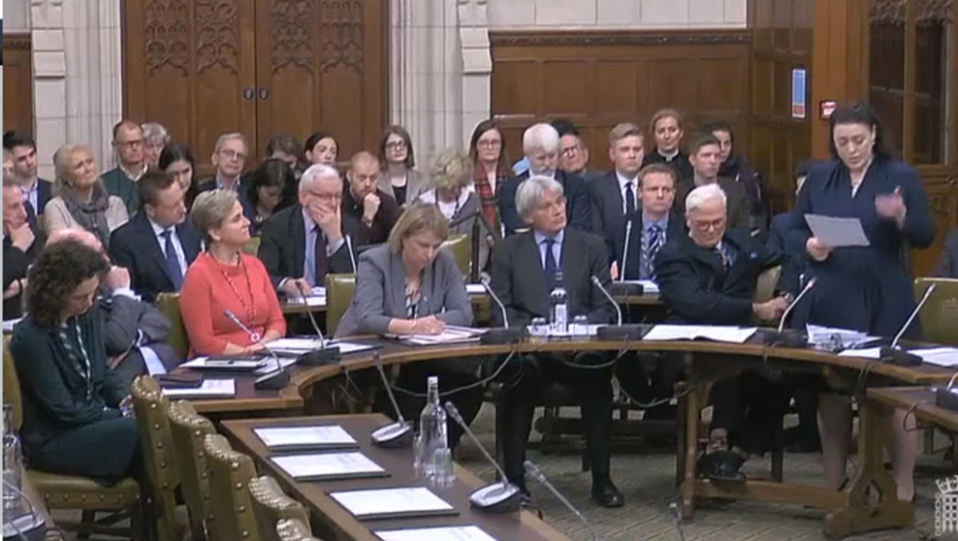
MPs from across the political divide have supported calls for an independent inquiry into assisted dying. My Death, My Decision welcomed MPs’ support on this issue. 

In a Westminster Hall debate, Christine Jardine MP, who called for the debate, acknowledged that her own views on assisted dying had changed after the death of her mother and that whilst she may have once been a ‘passive’ supporter she now saw it as incumbent upon herself to take action. In a bid to move beyond the current political impasse among MPs, she called upon the Government to consider formally issuing an investigation into the law on assisted dying as it stands. 

She said: ‘Perhaps the cruellest [fact] of all – it [the current law] can all be avoided if you can afford it. The law as it stands has created a two-tier system. If you have more than ten thousand pounds, you can travel to Switzerland or elsewhere for the end of life care of your choice.’ ‘… I have not used a word normally central to this debate and crucial to the campaigns which are going on outwith Parliament – and that word is compassion. That omission, on my part, is deliberate because for me in our law as it stands there is no compassion.’

Among other MPs who spoke in support of assisted dying, new MP Alicia Kearns spoke in support of Phil Newby, My Death, My Decision’s member, saying: ‘I’ve been struck by Phil’s considered and measured case and it sits with us to make a decision. The crux of the matter to me is to recognise the terror and agony to have your body turn on you and to wrack you with pain or torture you; for those suffering debilitating and terminal diseases are not just being robbed of life but also death.’ 

Later adding: ‘To come to terms with one’s own death, to depart this life in peace and dignity is a privilege I believe we should endeavour as a society to extend, not limit’. 

The latest pressure to review a change in the law follows after Phil Newby and Paul Lamb recently both had permission rejected by the High Court to challenge the UK’s prohibitive law

Despite efforts last year to call for an objective assessment of the law, including an open letter organised by My Death, My Decision and signed by a diverse range of thirty-four doctors, politicians, religious leaders, academics, and campaigners, the Justice Minister, Chris Philp, said the government was neutral in the debate and had no intention of introducing legislation. 

Trevor Moore, Chair of the campaign group My Death, My Decision said: 

‘Dying with dignity, in a manner of our own choosing, is a fundamental human right. It has now been almost half a decade since Parliament last examined the issue of assisted dying – and the evidence has changed. Progressive countries, including Canada, have proven a balance can be struck between stringent safeguards and respect for individual autonomy, medical opinion has shifted, new evidence has debunked claims palliative care and assisted dying are incompatible, and the number of Britons forced to end their life abroad has doubled to more than one person a week. 

Public opinion has now reached a record high and nearly 90% of the public support a change in the law. But, regardless of one’s view, we’d all surely agree assisted dying deserves a serious and robust discussion – our MPs need to be equipped with the latest impartial, independent and objective evidence. 

A call for evidence is essential.’

Read more

Open Letter to the Secretary of State for Justice

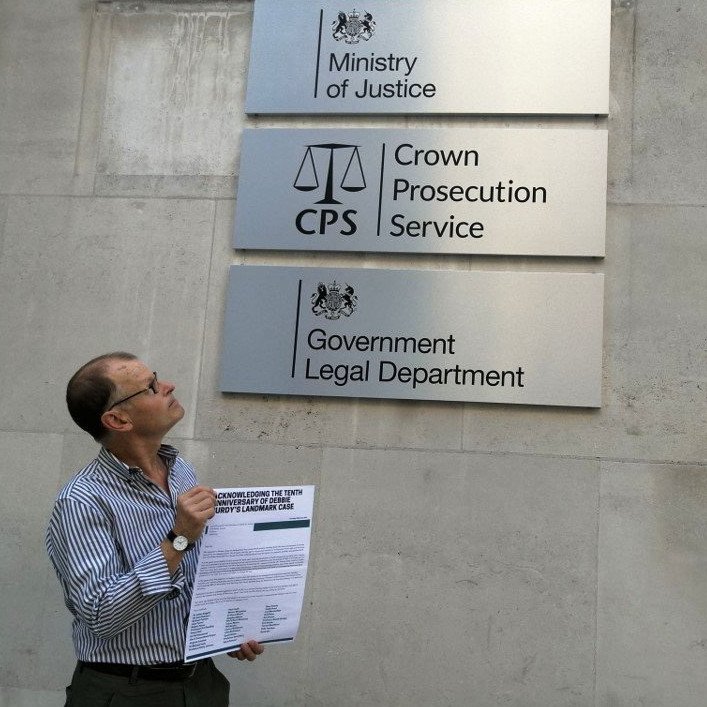
To mark the tenth anniversary of Debbie Purdy’s landmark assisted dying case, which resulted in the current Director of Public Prosecutions (DPP) guidelines on the Assisted Suicide law, My Death, My Decision has published an open letter to the incoming Secretary of State for Justice, Rt Hon Robert Buckland QC MP,  calling for a review into the working of the Assisted Suicide law in England and Wales. The Guardian published the letter on the anniversary date of 30th July. The call follows a recent parliamentary debate on the issue in which MPs made a similar call.

The full text of the letter is available here. The list of signatories is diverse and impressive, indicating the range of support MDMD has for its position and its growing influence. In addition to MDMD Chair Trevor Moore, the signatories include:

Medical Professionals:
Sir Iain Chalmers – Founder of the Cochrane Collaboration and acting coordinator of the James Lind Initiative
Dr Phil Hammond – Physician, Broadcaster, Comedian and Commentator
Dr Michael Irwin – Former Medical Director United Nations
Dr Henry Marsh – Physician and Author
Professor David Nutt – President of the European Brain Council
Professor Wendy Savage – General Medical Council and British Medical Association’s Ethics Committee Member
other members of MDMD’s Medical Group.

Philosophers:
Dr Julian Baggini – Philosopher, Journalist, and co-founder of the Philosophers’ Magazine
Professor A.C Grayling – Philosopher, Journalist, and founder of the New College of Humanities

Church Leaders:
Rev’d Canon Rosie Harper – Canon of Christ Church, Vicar of Great Missenden, Chaplain to the Bishop of Buckingham and member of the General Synod.
Rev’d Scott McKenna – Minister Mayfield Salisbury Church

Legal:
Professor Emily Jackson – UK Legal Scholar

Media:
Virginia Ironside – Journalist
Polly Toynbee – Journalist and Author
Andi Reiss – Independent film maker who made the documentary ‘Endgame‘.

Campaigners:
Andrew Copson – Chief Executive Humanists UK (Humanists UK is MDMD’s Assisted Dying Coalition Partner Organisation in England and Wales)
Paul Lamb – Currently bringing an Assisted Dying Court case.
Phil Newby – Currently bringing an Assisted Dying Court case.
Jane and Lauren Nicklinson – Assisted Dying Campaigners (Widow and Daughter of  Tony Nicklinson who brought an Assisted Dying Court Case)
Omar Puente – Assisted Dying Campaigner (Widower of Debbie Purdy)
MDMD supporters who have accompanied a relative to Switzerland for a medically assisted death that would not be permissible under a law limited to those with a life expectancy of 6 months or less, (as is the case in Oregon and which was rejected by the UK parliament in September 2015).

Other MDMD Patrons not included above:
Miriam Margolyes – Actor
Lord Martin Rees – Cross-bencher House of Lords

MDMD are most grateful to all signatories in coming together to support this call.

Read more

Parliamentary debate on the UK Assisted Suicide Law

On 4th July 2019 the House of Commons had the first opportunity to debate assisted dying since the Marris Bill failed in September 2015. The debate can be seen in full here. Prior to the debate MDMD circulated this briefing to MPs.

Nick Boles MP opened the debate by contrasting the death of his father, who ended his life by exercising his right to refuse life sustaining treatment, with that of Geoff Whaley who needed the currently illegal assistance of others for the good death he wanted. Nick Boles explained that “the purpose of today’s debate is not to propose a new law on Assisted Dying, but to understand the effect of the current law… It is only when we have fully understood all the different ways in which the current law impacts the British people that we should consider returning to the question… of what kind of change in the law might be justified.” He then called on the Lord Chancellor and the Secretary of State for Justice to initiate a formal call for evidence on the impact of our existing laws on Assisted Dying. He cited the very limited ability of parliament to gather evidence as a primary reason for this request.

The debate considered many points of view. Several MPs gave moving speeches describing very bad deaths that would have been vastly better had a compassionate Assisted Dying law been in force.  Paul Blomfield MP movingly described his father’s premature unassisted suicide.  “The current law forced my father into a lonely decision and a lonely death.” Although both he and his father strongly support improved end of life care and the hospice movement, he pointed out that “no hospice can enable everybody to die with the dignity that they would want”.  It was soon after a palliative care consultation that his father took the decision to end his life while he still could, without implicating anyone else. “If the law had make it possible he could have shared his plans with us. Knowing that he could, with support, go at the time of his choosing, would have enabled him to stay longer.”

Sir Norman Lamb MP gave further moving examples from his constituents which demonstrate ways in which the current law is failing. One case was a woman’s failed suicide which put her daughter in an impossibly difficult position as her Lasting Power of Attorney. He ended: “it is the individual and not the state who should decide, in a period of terminal illness, whether they bring their life to an end, and that is why the law should change.”

Crispin Blunt MP made the important observation that “The hard truth is that more of us are going to have to grapple with the pain and indignity of crippling progressive infirmities in later life and if we don’t change the law, even more people than the current 1 every 8 days may travel to Switzerland for an assisted death.”

Other MPs highlighted the unfairness of the current law, as the option of a medically assisted death in Switzerland is only available to those who can afford the cost; who are capable of handling the bureaucratic obstacles and who are capable of traveling to Switzerland, often earlier than they would wish.

Steve McCabe MP made a speech in which he referred to the Assisted Dying Coalition and the MDMD poll results. Although he voted against the Marris Bill, he believes the issue needs to be considered by parliament again. He expressed his concerns over a 6-month life expectancy restriction citing the difficulties doctors have in predicting this, and the suffering people it unfairly excludes. He explained that he was very moved by the case of Paul Lamb, saying “I think we need to focus on the quality of life, the capacity for life, and the rational sound judgement of a person who makes such a decision. Life expectancy in itself doesn’t tell us anything about suffering. So I think we should be considering Assisted Dying both in the context of terminal illness but also suffering and a lack of meaningful life.”

Those MPs opposed to changing the law referred to the traditional concerns: the protection of vulnerable people; the need for better palliative care; the views of disability groups; and religious sanctity of life.

Early on in the debate Lyn Brown MP intervened in Nick Boles’ opening speech to describe her mother’s death. She feared that if Assisted Dying had been available her mother would have spent her final months consumed by guilt and anxiety about when she should choose that option because she would have worried about the effect on her close family, the cost of her care, and the NHS resources she was taking up. Nick Boles responded to this by saying that any law would have multiple checks that the requestor was not pressurised by others to make their request. He described the checks that Dignitas make that ensure people are making their choice themselves.

This aspect of the debate is a clear example of the need for a careful gathering and assessment of evidence in the way Nick Boles requested. The concerns of vulnerability and coercion are very important. MDMD hopes that evidence gathering will address:

  • Evidence of the extent of coercion in other jurisdictions regarding requests for medically assisted deaths.
  • Any evidence of coercion in the working of the current law which allows people to refuse life-sustaining treatment to end their lives. (For example, Nick Bole’s father or the case of the “champagne suicide“.) Such people are just as open to coercion to end their life as others who would be eligible for assisted dying under an appropriate law. How do we  currently manage the risk of them being “consumed by guilt and anxiety” over whether or when to choose to refuse treatment as a means of ending their life? Is there any evidence to suggest that the same approach would be inadequate were Assisted Dying legalised?
  • Evidence of how reliably sufficient mental capacity is assessed in legislations which permit various forms of assisted dying, to ensure that anyone requesting an assisted death is making their own safe decision, free from undue persuasion, on a matter as serious as choosing to take their own life.

Some MPs referred to the opposition to Assisted Dying of most religious organisations, saying how they were in favour of Assisted Dying despite their own religious belief. Noel Conway‘s MP Daniel Kawczynski, a Roman Catholic, summed these views up when he said “Perhaps the Church doesn’t always get everything right when it comes to how human beings behave, interact, and ultimately decide to die.”

A number of MPs, including Vince Cable, stated that they had changed their mind on the issue since the Marris Bill debate. In closing the debate Nick Boles said: “I have changed my mind about this issue. Many people have changed their minds about this issue. I hope that more people will change their mind about this issue so that we can get on and change the law and make this country a more humane place for people to live and die.” These are sentiments that MDMD wholeheartedly endorse, but there is still a very long way to go.

Read more

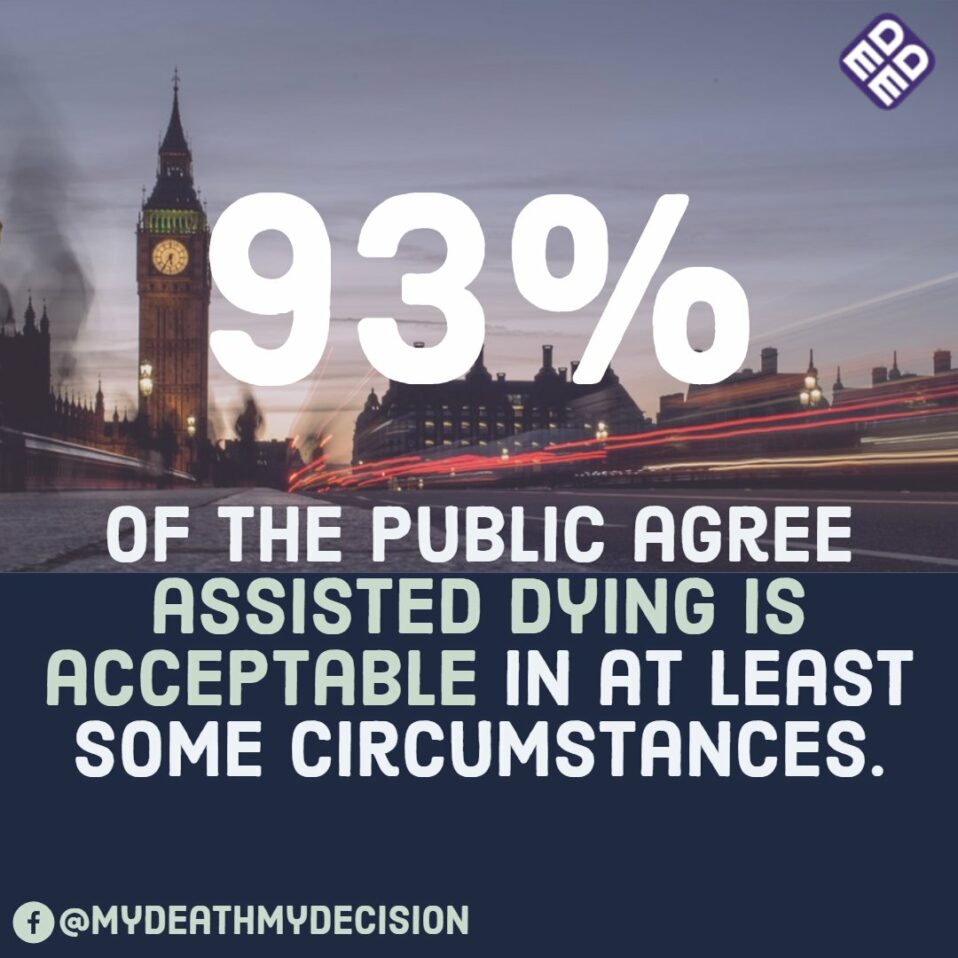
93% think that assisted dying is acceptable in at least some situations

My Death, My Decision’s Campaign Policy Director, Phil Cheatle, breaks down the new research commissioned by MDMD.

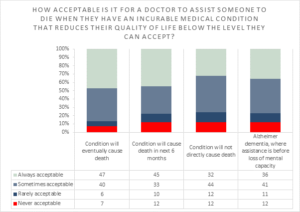
MDMD has released the results of research it sponsored through the National Centre for Social Research (NatCen). The work tested public acceptability of various forms of assisted dying. In all cases considered the person is suffering from an incurable illness and feels their quality of life in below the level they are prepared to accept (or will soon become so). They have sufficient mental capacity to make a life-ending decision and have considered this option carefully, discussing it with professionals who have agreed that their request is within the (hypothetical) law. The different conditions tested were:

  • Those who are suffering from an illness which will eventually cause their death (regardless of timescale).
  • Those who are expected to die from their illness within 6 months.
  • Those whose illness will not cause death
  • Those suffering from Alzheimer’s disease before they lose the mental capacity to make a life ending decision.

The results are discussed in detail here.

What is astounding about these results is the very high level of support for all these forms of assisted dying. Depending on the scenario, between 88% and 93% of respondents thought it acceptable in at least some situations. Comparing results between the scenarios, it demonstrates clearly that public opinion is strongly in favour of the sort of broader approach to assisted dying favoured by MDMD, as opposed to narrower approaches based on the law in Oregon which limit assisted dying to those who are within 6-months of dying. MDMD is proud to be a founder member of the newly formed Assisted Dying Coalition which brings together the UK organisations campaigning for this broader approach to assisted dying.

We were surprised that the research found that the strongest support was for those whose illness would eventually kill them, regardless of timescale. In this situation 93% of respondents thought that a medically assisted death was acceptable in at least some situations. That is a huge majority.

The current law in the UK prevents assisted dying in all situations. Our new research shows that the doctors and politicians who continue to oppose a change in this law are even more out of tune with the people they are supposed to be serving than was previously thought. How can we have confidence in the medical profession if they do not respect our rational end-of-life wishes? How can we have confidence in our politicians if they refuse to change a law which makes some people suffer unnecessarily, against their will at the end of their lives – making others decide to go to Switzerland for medical assistance to end their lives, often too soon?

Palliative care is a wonderful service that helps many people – and could help even more with increased funding. But even the best palliative care can not help in all situations. I recently asked Baroness Finlay, a leading professor of palliative care and strong opponent of assisted dying, how I could avoid an unpleasant end of life like my mother’s, if I too was diagnosed with dementia. Her answer – to look on the internet for illegal lethal drugs – is totally unacceptable and shocking. 88% of people in our poll think that in some situations like this, assisted dying is acceptable. We demand a more compassionate, patient-centred approach to avoiding end-of-life suffering, an approach that includes medical assistance to die as a last resort.

Of course, agreeing that it would be “acceptable for someone to have medical assistance to die” is significantly different from agreeing to a specific change in the law, where all the safeguards have been carefully thought through. But what is clear is that the debate now needs to move on. We should be no longer discussing whether or not assisted dying should be permitted, but instead be working on the details of how assisting dying can be safely and comprehensively introduced, ensuring adequate protection for those who may be vulnerable. In doing so we should learn from other jurisdictions where some form of assisted dying is permitted.

It is bitterly disappointing that the palliative care medical community are so reluctant to talk constructively about improving end-of-life choice when it includes assisted dying. In the eyes of 93% of the people surveyed, that can only undermine the reputation of palliative care. That is unfortunate, as good, comprehensive, patient-centred, palliative care is an important component in ensuring that as many as possible have, what for them, is a good death.

You can read our full description of the poll and results here, with technical information here.

Update August 2019:

MDMD are pleased to see that our poll methodology was replicated by End of Life Choices, Jersey. They commissioned 4insight to run a poll with the same questions for 1,420 Jersey inhabitants. The results are in line with the MDMD results and in some cases show slightly stronger support. The Jersey report can be read here.

Read more

The Legacy of Debbie Purdy – Radio 4 programme

BBC Radio 4 recently broadcast a 2 part programme about Debbie Purdy. The first part is a dramatisation of the story of how Debbie took her legal case to the House of Lords and as a result caused the director of public prosecutions, (DPP), to issue guidelines clarifying the facts to be considered when deciding whether someone should be prosecuted for assisting suicide. Debbie was concerned that her husband might be prosecuted if he helped her to go to Dignitas in Switzerland, where she could have a medically assisted suicide. (The DPP at the time was Keir Starmer, who is now a front bench Labour MP, and shadow Brexit secretary.) It is 10 years ago this year that Debbie won her case.

In the second part of the programme, The Legacy of Debbie Purdy, Deborah Bowman discusses the issues raised by Debbie’s case with her husband, Omar Puente, her solicitor, Saimo Chahal, and Lord Falconer, the barrister and Labour peer who campaigned on the issue in Parliament.

In recalling the day of the House of Lords ruling on the Purdy case, Lord Falconer said, ‘What Debbie and Omar achieved was absolutely epochal in relation to the struggle because it forced the government, the DPP, to set out what were the circumstances which would lead you to be prosecuted for helping someone to take their own life and what would be the circumstances that would mean you wouldn’t be prosecuted.‘ The resulting DPP guidelines are available here.

The programme raised the recent case of Geoff Whaley, in which his wife, Ann, was interviewed by the police under caution, prior to assisting Geoff to go to Switzerland for a medically assisted death there. The presenter asked ‘Why are friends and family still vulnerable to investigation and potential prosecution given Debbie’s case?

Lord Falconer explained that ‘there are still lots of problems because they are dependent on the discretion of the DPP. He decides if there is any bad motivation on the part of the family or friends who helped their loved one take their own life.

Asked why his attempts to change the law failed when Debbie Purdy’s case was won, Lord Falconer went on to say ‘I think parliament is totally out of tune with the public’s view… Politicians come into politics to deal with schools and hospitals and issues like that and this is a side issue for them.’

In 2014 Lord Falconer put forward a private member’s Bill in the House of Lords for an assisted dying law along the lines of the Death with Dignity law in Oregon USA. His Bill made significant progress by passing its second reading, but it ran out of time due to the general election of 2015. (Essentially the same Bill was re-introduced in the House of Commons by Rob Marris following the election, but was defeated at its second reading.)

Saimo Chahal, Debbie’s solicitor, went on to represent Tony Nicklinson, who suffered from locked in syndrome. More recently she represented Omid in his legal challenge for assistance to die. She raised the issue of people with degenerative diseases which mean that they would not be helped by the kind of Bill proposed by Lord Falconer as they are not expected to die within six months, but have much longer to suffer. She quoted Lord Neuberger, one of the law lords who ruled in the Nicklinson case, saying surely these people are even more deserving of our sympathy than those who only have a few months to suffer.

Although the Nicklinson and Omid cases failed, the Nicklinson case did help persuade ex Archbishop of Canterbury, Lord Carey to change his view on assisted dying, so that he now supports assisted dying for cases such as these.

Lord Falconer was asked why he proposed a law that would only help those with six months or less to live. He replied ‘Authorising people to assist somebody to die should be limited to those who are dying already. I think that by and large being opposed to helping people to commit suicide is the right policy position for the state to be in, however if you are dying you should have choices as to how you die.

The presenter pointed out the medical difficulties of making an accurate life-expectancy prognosis, which Lord Falconer accepted, but said that doctors had to make difficult decisions all the time.

Saimo Chahal agreed with Lord Falconer that there was an underlying principle of personal autonomy over end of life wishes which should be respected, but she said ‘I personally cannot understand why people who have 6 months or less should be helped but not people who have a degenerative condition which is life shortening, who have years and years of pain and agony ahead of them. It seems to me that those very people deserve to have autonomy over when they bring their lives to an end.

Lord Falconer responded that ‘the problem is that if suffering becomes the test, you are asking the law to make quite difficult decisions’. He went on to highlight the difficulties with people who are suffering from extreme depression.

Clearly there are difficult decisions to be made – both medical and legal. What seems to be missing is agreed guidelines to tackle them both, while providing adequate protection from those who may be coerced to act against their “true” wishes. It is unfortunate that the programme was not able to explore this point further. It is instructive, for example, to compare the existing right of someone to refuse life-sustaining treatment, or to refuse food and liquid, in order to end their life, but the absence of a right to request medical assistance to die when faced with incurable suffering. Two recent cases highlight this issue, both with motor neurone disease. John King ended his life by removing his ventilator, but Noel Conway’s legal challenge was refused, partly because he has this option of removing his ventilator which he could choose. We should note that the criteria which separate these very similar cases do not involve issues of the risk of coercion, nor any estimate of life-expectancy. Surely it cannot be acceptable to force people to suffer from incurable conditions against their will when they are not dependent on life-sustaining treatment which they could refuse, or where such refusal of treatment could lead to a protracted and unpleasant death.

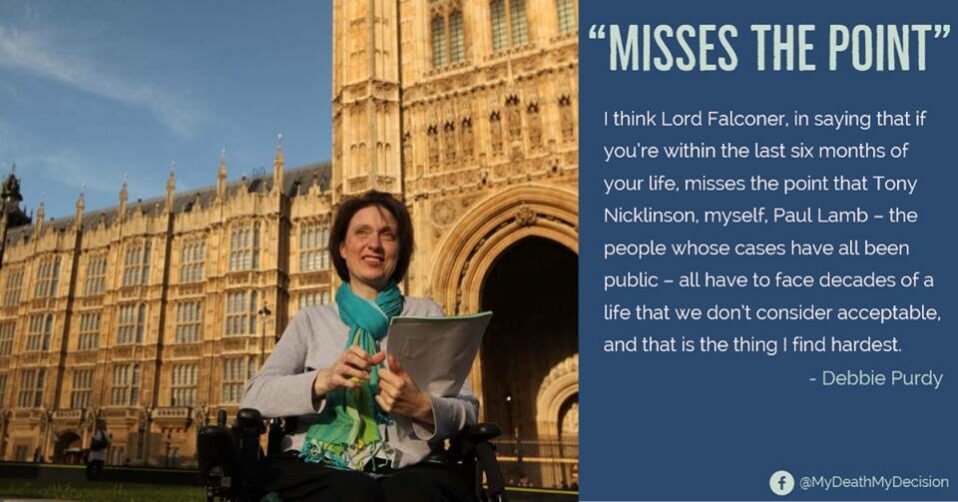
One thing that wasn’t pointed out was that in her final interview Debbie’s views on the six month issue were very clear: ‘I think Lord Falconer, in saying that if you’re within the last six months of your life, misses the point that Tony Nicklinson, myself, Paul Lamb – the people whose cases have all been public – all have to face decades of a life that we don’t consider acceptable, and that is the thing I find hardest.‘ Saimo Chahal was clearly echoing Debbie’s point of view.

Despite these limitations, the programmes are both fascinating. It is particularly helpful to hear a discussion on the issue of the six month criterion – something that MDMD has strong views on.

The progammes are available for a limited time here:

https://www.bbc.co.uk/sounds/play/m0002r4f

https://www.bbc.co.uk/sounds/play/m0002r4h

Read more